
Blog
Your Topics | Multiple Stories Explained: Topics, Feeds, Order

If you’ve seen the phrase Your Topics | Multiple Stories and wondered what it means, you’re not alone. It often shows up in places where content is grouped, sorted, or recommended based on themes you follow. The wording can feel a little technical, but the idea behind it is simple: you choose topics you care about, and the system shows you multiple stories related to those topics in an organized feed.
This guide explains how topics work, how feeds are built, and what “order” usually means in this context. You’ll also learn how to adjust your experience so you see more of what you want and less of what you don’t, without getting overwhelmed.
What “Your Topics | Multiple Stories” Usually Refers To
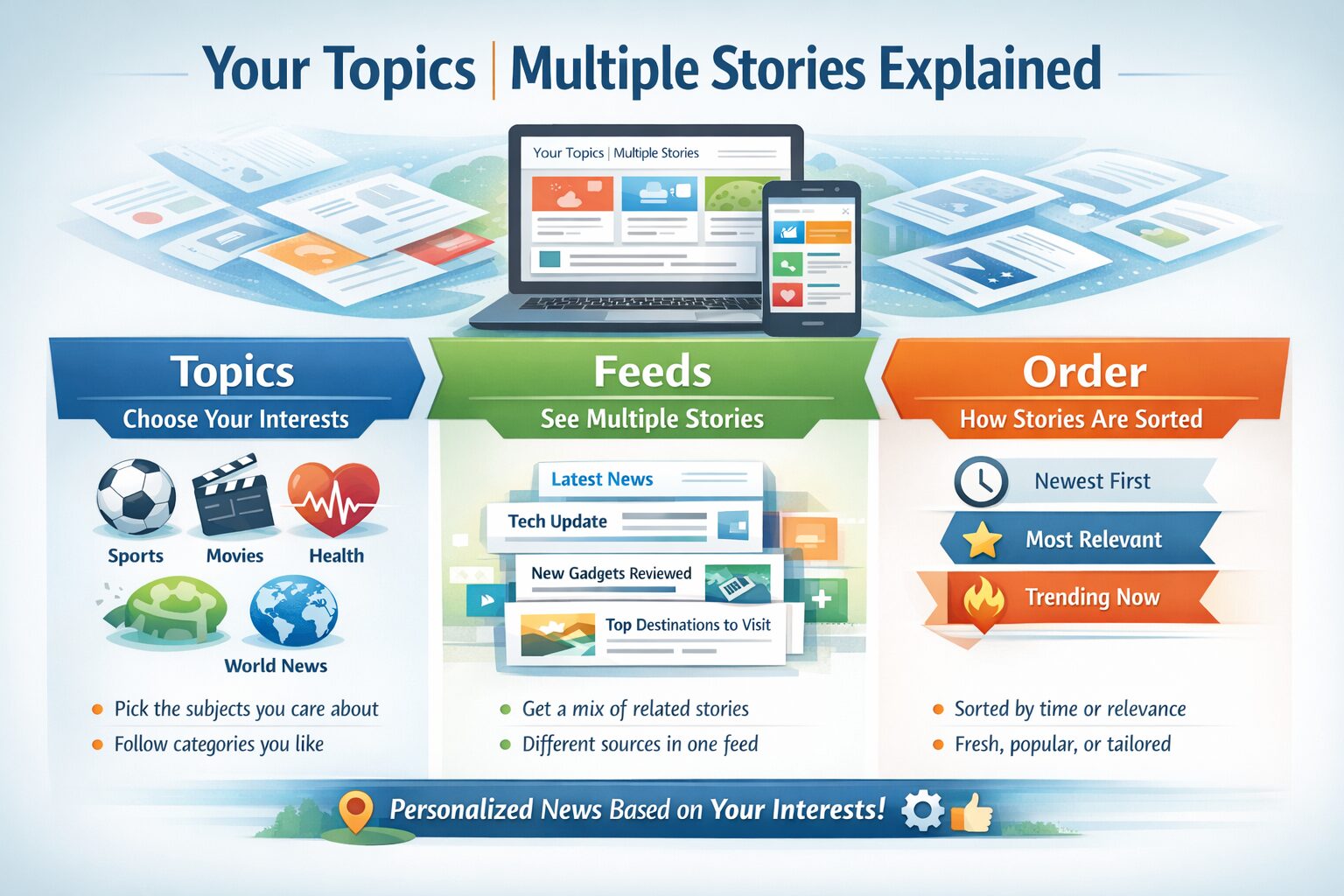
In most platforms, “topics” are labels that describe what a story is about—like sports, tech, health, finance, movies, or local news. When you follow or select topics, the platform uses them to pull in related updates. The “multiple stories” part means it won’t show just one item. Instead, it presents a group of posts, articles, videos, or updates that match the topic.
Sometimes this phrase appears as a section title, a filter name, or a layout label. It can also be part of a content template used across a site or app. Either way, the meaning stays consistent: it’s a way to bundle related content so you can scan and choose what to read next.
Topics: How the System Knows What You Care About
Topics come from a mix of choices and signals. The most direct way is when you manually select interests—by clicking follow, choosing categories, or picking preferences during setup. The system may also learn from what you read, what you skip, what you save, and what you hide. Over time, it builds a profile of what seems relevant to you.
The key thing to understand is that topics are not always perfect. Two different people may read the same story for different reasons, and the system might not know that. That’s why topic controls matter. When you can adjust topics directly, you can guide the feed toward the kind of stories you truly want.
Multiple Stories: Why You See Several Items at Once
Showing multiple stories per topic is meant to help you compare coverage and find the angle that fits your needs. For example, one story might be a quick summary, another might be a deep analysis, and a third might be a local update. Seeing them together gives you options without forcing you into one source or one format.
It also reduces the chance that a single headline shapes your whole understanding. If several items appear under the same topic, you can spot patterns, notice what’s repeated, and avoid jumping to conclusions based on only one post. For many readers, this grouped approach feels calmer and more useful than an endless mixed stream.
Feeds: The Difference Between a Topic List and a Feed
A topic list is your set of interests. A feed is the living stream of content built from those interests. Think of it like this: topics are ingredients, and the feed is the meal that changes each time you open the app or site. Even if your topics stay the same, the feed updates constantly as new stories are published.
Feeds can also include content outside your topics. Some platforms blend in general trends, local updates, or popular posts to keep things fresh. If your feed feels too random, it usually means the platform is mixing in broader recommendations more than you prefer. If it feels too narrow, it may be showing only the strict topic matches.
Order: What Controls the Sequence of Stories
“Order” usually refers to how stories are sorted. The most common sorting styles are newest-first, most relevant, most popular, or a mix that tries to balance freshness with interest. Relevance often includes factors like your reading history, how closely the story matches your topic, and how similar users responded to it.
Order is also influenced by format. Short updates might appear before long reads, or videos may be placed higher if you tend to watch them. In some systems, “order” is not a setting you control directly, but you can still influence it by changing your topic preferences and feedback signals, like hiding certain types of posts.
Why the Same Topic Can Show Different Feeds for Different People
Two people can follow “sports” and still get very different feeds. One person might see soccer and basketball, while another sees cricket and tennis. That’s because topics often have layers. Under a broad topic are smaller subtopics, teams, regions, and related keywords. The system uses what it knows about you to decide which part of the topic should lead.
Location can also affect your feed, even for global topics. If a platform thinks local updates matter, it may prioritize stories tied to your region. Language preferences, reading time, and device type can also shape what appears first. This is why it’s normal for feeds to feel personalized, even when the topic name looks the same.
Common Reasons Your Feed Feels “Out of Order”
If your feed feels messy—like important stories are buried or repeats show up—there are a few likely causes. One cause is story duplication, where the same event is posted by many sources with slightly different headlines. Another is a sudden topic shift, where one click or search makes the system think you’re deeply interested in something you only checked once.
It can also happen when the platform tries to blend breaking updates with evergreen content. You might see a fresh headline followed by an older explainer that is still relevant. That mix can be helpful, but it can also feel confusing if you expect strict time order. Learning how your platform treats freshness versus relevance helps you interpret what you’re seeing.
Practical Ways to Improve Your Topics and Feed Quality
Most platforms give you at least a few control tools, even if they look different from one place to another. The most effective actions usually involve refining your topics, correcting wrong assumptions, and limiting unwanted categories. Small changes can have a big impact because the feed updates continuously based on your latest signals.
Here are a few simple actions that often improve results quickly:
-
Follow a few specific topics instead of only broad ones
-
Unfollow or mute topics that keep bringing unwanted content
-
Use “hide,” “not interested,” or similar options consistently
-
Save or like the type of stories you want more often
-
Clear or reduce certain history signals if the platform allows it
Use these tools lightly but consistently. A feed usually improves with steady feedback rather than constant major resets.
Understanding Topic Labels, Subtopics, and Grouped Sections
Sometimes the confusion comes from labels that are too broad. A topic like “technology” can include phones, software, AI, cybersecurity, startups, and much more. A well-built system will break that into subtopics and show grouped sections, such as “Mobile,” “Gadgets,” or “Security.” If you see grouped sections under Your Topics | Multiple Stories, that usually means the system is clustering stories inside the same general theme.
This clustering is helpful when it works well, but it can also mislabel stories. A business headline about a tech company might be shown under both “business” and “technology.” That’s not necessarily wrong—it’s just the system recognizing overlap. If overlap becomes annoying, you may need to narrow the topics you follow or reduce broad categories.
How to Spot Low-Quality or Repetitive Story Groups
Not every group of “multiple stories” is equally useful. A strong group should offer variety: different angles, sources, or formats. A weak group often repeats the same facts with slightly changed wording, or it stacks opinion-heavy posts without clear reporting. When you notice repetition, it’s a sign the topic is pulling from too small a pool or the feed is over-optimizing for engagement.
You can often improve this by expanding the range of topics slightly or adding a few related interests that bring in more diverse coverage. You can also reduce repetition by hiding duplicate posts when you see them. If the platform learns that duplicates annoy you, it may start filtering them out more aggressively.
When “Your Topics | Multiple Stories” Is a Layout Name, Not a Feature
In some cases, the phrase isn’t something you set up at all. It may be a template label used by a website, a news widget, or a content plugin. That means you can’t always “turn it on” or “turn it off” because it’s just the name of a section that shows grouped content.
If you suspect this is the case, look for signs like the phrase appearing in the same spot every time, across many pages, without any clear settings menu. Even then, you can often influence what appears by adjusting your account preferences, your follows, or your reading habits—if the site supports personalization.
Troubleshooting: What to Do If It Doesn’t Match Your Interests
If the topics feel wrong, start with the simplest fix: review your topic list. Remove anything you don’t truly care about and add a few specific interests that better match your goals. If you’re using a shared device or account, remember that other people’s activity can affect the feed too.
If the platform offers a reset option for recommendations or history, that can help when the feed has drifted far from what you want. But resets are a big step, and they can make the experience feel generic for a while. Many users get better results by making smaller edits first, like muting one noisy topic or correcting a few wrong suggestions.
How to Use Topic Feeds Without Feeling Overwhelmed
A well-tuned topic feed should save you time, not create stress. One helpful habit is to treat grouped stories as a menu, not an obligation. Scan headlines, pick one or two items that truly matter, and move on. You don’t need to read everything in the group for it to be useful.
Another helpful approach is setting a simple routine. For example, you might check your topics once in the morning and once later in the day, instead of opening the feed repeatedly. When you check less often, the groups feel more meaningful because there’s enough new content to justify the visit. This makes the “multiple stories” structure feel like a feature rather than noise.
Final Thoughts / Conclusion
Your Topics | Multiple Stories is a straightforward idea wrapped in a slightly confusing phrase. It’s about choosing interests, receiving grouped updates, and seeing content in an order shaped by freshness and relevance. Once you understand how topics, feeds, and sorting work together, you can take simple steps to make the experience cleaner and more useful.
The biggest wins usually come from refining your topic list, giving consistent feedback on what you want, and learning how the platform sorts stories. With a few small adjustments, the feed becomes easier to scan, easier to trust, and much closer to what you actually came for.
FAQs
What is Your Topics | Multiple Stories in simple terms?
It’s a way of organizing content by interests you follow and showing more than one related item at a time. Instead of one headline, you get a small group of stories tied to the same topic. This helps you compare coverage and choose what to read.
Is Your Topics | Multiple Stories a feature I can turn on?
Sometimes it is, especially on apps that let you follow topics and manage preferences. Other times it’s just the name of a section or layout used by a site. If you can’t find settings, it may be a built-in label rather than a switchable feature.
Why do I see stories I don’t care about under my topics?
Topics can be broad, and the system may guess what fits based on limited signals. One click can sometimes cause the feed to assume a stronger interest than you intended. Adjusting topics and using “not interested” tools usually corrects this over time.
What does “order” mean in topic feeds?
Order is how the feed sorts items, such as newest-first, most relevant, or a blended mix. Relevance may consider your reading habits, the story’s topic match, and general popularity. If you can’t change order directly, your feedback still influences what rises to the top.
How do I make the feed show more useful stories?
Focus on specific topics, remove broad ones that bring too much noise, and use hide or mute options for unwanted content. Also, engage more with the kinds of stories you want, such as saving them or reading them fully. Over time, the system usually adapts.
Why do I keep seeing the same story in different forms?
Major events are often covered by many sources, and platforms may pull several versions into the same topic group. That can look like repetition, even if the headlines differ. Hiding duplicates and refining topics can reduce how often this happens.
Does my location affect Your Topics | Multiple Stories?
Yes, many systems consider location when choosing what to show, especially for news, sports, and local events. Even global topics may be filtered toward regional angles. If location-based content feels too strong, look for settings related to local updates or regional preferences.
What should I do if my topics got messy after one search or click?
Start by removing or muting the topic that changed the feed the most. Then use “not interested” on a few unwanted items so the system gets a clear signal. If available, you can also review history or recommendation controls to reduce the impact of that one action.
ALSO READ THIS : Davisgonensfw Guide: What to Know Before Opening NSFW Posts

Best Movirz Alternatives for Streaming Movies Online

Who Is Erin Trussell? Full Details About Duncan Trussell’s Wife and Personal Life

What Is Twizchat and How Does It Work for Users Today

What Is SosoActive and How Does It Work for Users

How to Identify 2RSB9053 Parts and Their Key Features

What Is Caricatronchi and How Does It Work Today

What SocialWick offers for safe social media growth

What Is Cumhuritey and How It Works Around the World

What Is Hormita and How It Is Used Around the World

How Pappedeckel Helps in Packaging and Daily Use

Galoble

MMSVEE24 Explained in Simple Terms for Beginners
What SocialWick offers for safe social media growth
Best Movirz Alternatives for Streaming Movies Online

HeilxStudio
How Pappedeckel Helps in Packaging and Daily Use
Who Is Erin Trussell? Full Details About Duncan Trussell’s Wife and Personal Life
What Is Cumhuritey and How It Works Around the World
How to Identify 2RSB9053 Parts and Their Key Features
What Is Twizchat and How Does It Work for Users Today
Best Movirz Alternatives for Streaming Movies Online
Who Is Erin Trussell? Full Details About Duncan Trussell’s Wife and Personal Life
What Is Twizchat and How Does It Work for Users Today
What Is SosoActive and How Does It Work for Users
How to Identify 2RSB9053 Parts and Their Key Features
What Is Caricatronchi and How Does It Work Today
What SocialWick offers for safe social media growth
What Is Cumhuritey and How It Works Around the World
What Is Hormita and How It Is Used Around the World
How Pappedeckel Helps in Packaging and Daily Use
-

 Technology4 months ago
What Is 001-gdl1ghbstssxzv3os4rfaa-3687053746? Uses Explained
-

 Celebrity3 months ago
Who Is Lauren Deleo? What to Know About Jake Lacy’s Wife
-

 Celebrity4 months ago
Who Is Debra Peifer? The Untold Story Behind Zach Bryan’s Rising Fame
-

 Blog4 months ago
What Is cilkizmiz24? Explained Clearly: Meaning, Use, and Notes