
Blog
Y15ZR Say Sorry vs EG Civic: Speed and handling overview

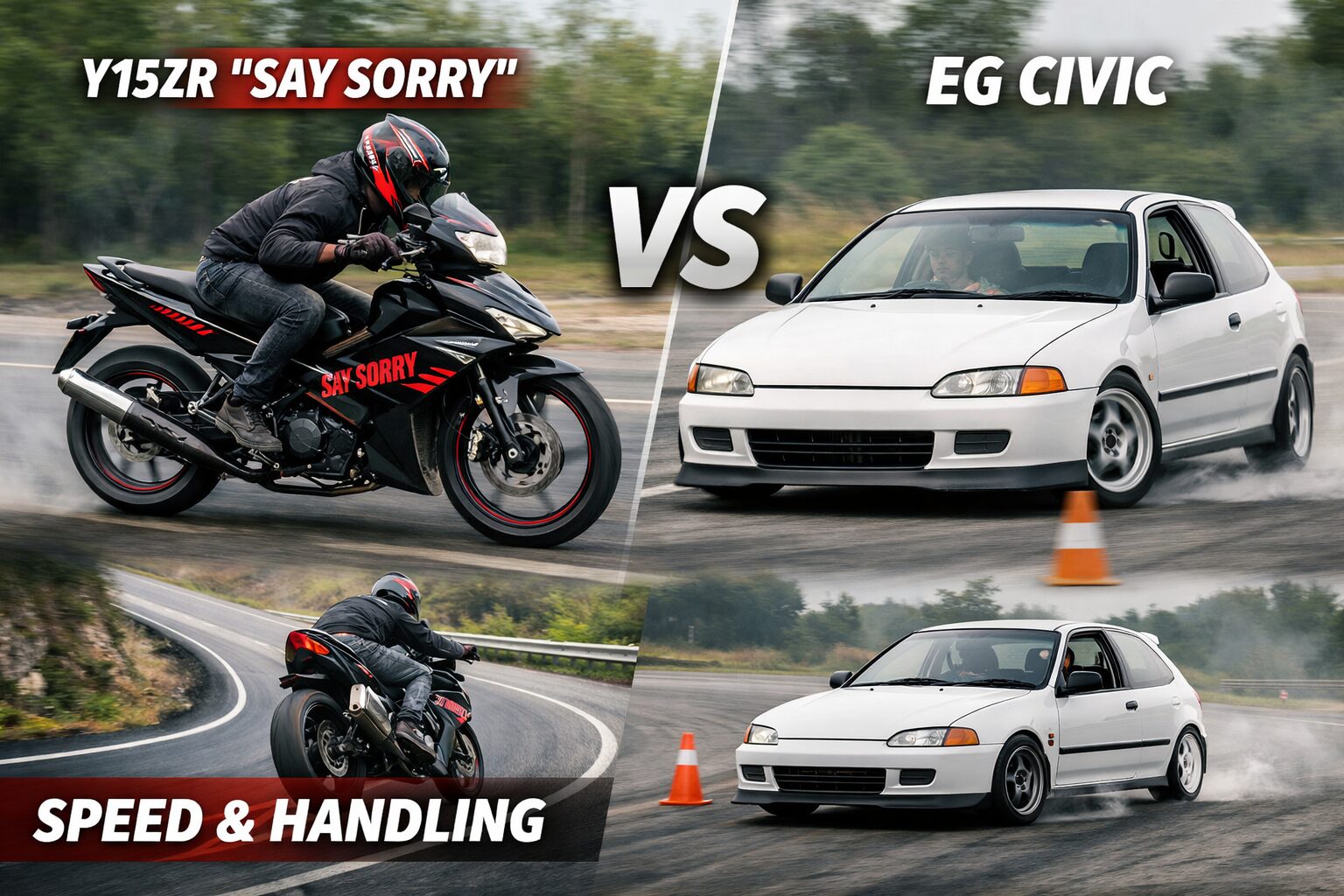
When people search Y15ZR Say Sorry vs EG Civic, they’re usually trying to understand a popular real-world matchup: a lightweight 150cc underbone motorcycle versus an older Honda Civic EG hatch/sedan. On paper, it can sound like an unfair comparison. In real life, it depends on distance, surface, driver and rider skill, and how each machine is set up.
This article breaks it down in plain terms. You’ll learn what the names often mean, why these two get compared so much, and what actually decides speed and handling when they line up—whether it’s a short pull, a longer run, or a twisty road.
Understanding the matchup
What “Say Sorry” often means in the Y15ZR scene
“Say Sorry” is commonly used as a nickname or label in street-race and motorcycle community posts. In many places, it’s not an official model name or factory version. It can be tied to a specific build theme, a local racing group, a sticker set, or a well-known bike that inspired others to copy the look.
That matters because two bikes that both get called “Say Sorry” might not be built the same. One might be mostly stock with small upgrades, while another might have gearing changes, clutch work, or weight reduction. So if you see the phrase online, treat it as a community tag, not a technical spec sheet.
Why people compare a 150cc bike to an EG Civic at all
At first, comparing a small motorcycle to a car seems odd. But it makes sense for two reasons. First, both are common and easy to modify in many countries, so people actually have access to them. Second, both can be quick in their own way: the Y15ZR is light and can jump forward fast, while an EG Civic can be tuned for strong mid-range pull and better stability at speed.
The matchup also stays popular because it’s close enough to be interesting. If the Civic isn’t heavily built, and the run is short, the bike can look “impossible to catch.” If the Civic is well-prepped and the road gives it room, the story can flip. That back-and-forth is exactly what keeps the debate alive.
Speed and acceleration basics

In most short runs, the biggest advantage is not “horsepower” by itself. It’s how quickly a machine can turn its power into forward motion. A light bike with decent torque and short gearing can feel explosive because it has less mass to move. It also has less drivetrain loss than many cars, and shifting can be fast when the rider is sharp.
Cars fight a different battle. They carry more weight, but they can put power down through four contact patches and often keep traction better once moving. Aerodynamics, gearing, and stability start to matter more as speeds rise. That’s why the “who wins” answer changes depending on distance and surface.
Where a Y15ZR usually feels quickest
A Y15ZR-style 150cc underbone shines at the very start of a run. It’s compact, light, and responsive. In tight spaces—like quick pulls between traffic gaps, short straight roads, or low-speed sprints—the bike can jump ahead before a car even gets fully hooked up.
The rider’s technique is also a major factor. A clean launch, quick but smooth shifts, and keeping the engine in the right power band can make a modest bike look much faster than it is. If the surface is decent and the rider is confident, the bike’s early lead can be hard to erase in short distances.
Where an EG Civic can pull back and pass
An EG Civic has advantages that show up once the race stretches out. The car is more stable at higher speed, and it can keep accelerating without the same wind resistance penalty a rider faces. A bike and rider create a lot of drag compared with a small hatchback, especially if the rider is sitting upright.
The Civic also benefits from momentum once it’s moving. If it has solid tires, a well-matched gearbox, and enough power to keep pulling through the mid range, it can start closing the gap. On longer runs, the car’s ability to stay planted and keep power down can turn a early loss into a late win.
Handling and road feel
Turning, grip, and why “handling” is not one thing
Handling means different things depending on where you ride. In tight corners and quick direction changes, a small bike can feel effortless. It can lean, turn, and recover fast, and it doesn’t need as much space to set up for a corner. On narrow roads, that can be a real advantage.
But handling also includes stability—how calm the machine feels when the road is rough, when you brake hard, or when you hit higher speeds. A car has a wider track, a longer wheelbase, and more predictable grip from four tires. So the bike may feel sharper in tight turns, while the Civic may feel more confident when speeds rise or the road gets uneven.
Braking, stability, and the “confidence gap”
Braking is often where the biggest real-world difference shows up. Many riders can brake very hard, but it takes skill and good tires to do it safely. A bike’s weight shifts forward under braking, and it’s easier to lock a wheel or upset the chassis if the surface is dusty or bumpy.
An EG Civic, even an older one, usually gives the driver more stability during hard braking and quick lane changes. That doesn’t mean it always stops shorter, but it often feels more controlled and less risky for average drivers. In real life, that confidence gap matters. A rider who is nervous will brake early and lose speed; a driver who feels planted might keep pace longer.
How to compare fairly
If you want a comparison that makes sense, the goal is to reduce “hidden advantages” and focus on the machines and the people controlling them. Here’s a simple checklist that keeps things honest and easy to repeat:
-
Use the same road and direction for each run to limit wind and slope effects
-
Pick a clear distance (for example: 0–100 meters and 0–400 meters)
-
Agree on a start rule (roll start at a set speed, or a safe, controlled launch)
-
Check tire condition and pressure on both machines before testing
-
Make sure both are fully warmed up and running correctly
-
Keep fuel level similar and remove extra cargo to reduce weight swings
-
Do multiple runs and ignore one “bad run” caused by a missed shift or wheelspin
With a setup like this, you’ll get results that explain the matchup instead of creating more arguments.
Safety and respect matter more than winning a clip
It’s tempting to treat this matchup like a simple bragging contest, but the risks rise fast when speed and ego mix. Public roads add unknowns: loose gravel, hidden potholes, sudden traffic, animals, and pedestrians. Even a small mistake can lead to serious injury or worse.
If you’re comparing speed or handling, do it in a controlled place where you’re not putting others in danger. Wear proper safety gear on a bike, and make sure both machines are mechanically sound. The “fastest” result is meaningless if it comes with avoidable harm. A smart comparison is one you can repeat safely, not one you survive once.
Final Thoughts / Conclusion
So what’s the real takeaway from Y15ZR Say Sorry vs EG Civic? In short runs, the Y15ZR’s light weight and quick response can create a strong early lead, especially with a skilled rider and a setup that favors acceleration. Over longer distances, the EG Civic’s stability, traction, and better aerodynamics can help it close the gap and sometimes pass.
Handling is also a split story. The bike can feel sharper and more agile in tight spaces, while the Civic often feels calmer when braking hard or carrying speed on rough roads. If you want a real answer for your own situation, focus less on hype and more on distance, surface, setup, and skill. That’s what decides the outcome far more than the names.
FAQs
What does “Y15ZR Say Sorry” actually mean, and is it an official model?
It’s usually a community nickname, not a factory edition. People use it to describe a certain build style, local racing identity, or a well-known bike that became popular online. Because it’s informal, two bikes with that label can be very different in performance.
Is it fair to compare a 150cc bike to an EG Civic in the first place?
It can be fair if you define the test clearly. A bike and a car win for different reasons, and distance changes everything. If you compare a short sprint and a longer run, you’ll often see each machine’s strengths show up in different parts of the test.
Which one is faster in a short pull, like 100 to 200 meters?
Many times, the Y15ZR can look faster early because it launches quickly and has less weight to move. But results can flip if the bike struggles for grip, the rider misses a shift, or the Civic has strong low-end power and hooks up well.
Which one tends to win over a longer distance, like 400 meters or more?
A well-sorted EG Civic often does better as speed rises because it stays stable and cuts through the air more efficiently than a rider sitting in the wind. That said, a strong bike setup and a skilled rider can still keep it close. The key is how much power each one can keep using as speeds build.
Does handling mean the bike is always better in corners?
Not always. The bike may turn quicker and feel more agile in tight bends, especially on narrow roads. But the car often feels more stable when braking hard, changing lanes, or driving over rough patches at speed. “Better handling” depends on the road type and the skill of the person driving or riding.
What upgrades change this matchup the most without going extreme?
On the bike side, gearing, clutch tuning, tire choice, and reducing unnecessary weight can make a big difference in short runs. On the Civic side, tires, suspension setup, traction, and a gearbox that matches the power delivery matter a lot. Good maintenance also matters more than people think—poor tuning or worn parts can erase any advantage.
Why do results look different from one video to the next?
Because many details are hidden. Road slope, wind, surface grip, rider confidence, driver reaction, and the exact start rule can change the outcome quickly. Also, “stock” often means different things to different people, so two vehicles that look similar may not perform the same.
How can I compare them without risking anyone’s safety?
Choose a controlled location and focus on repeatable tests rather than risky stunts. Make sure both machines are mechanically safe, use proper protective gear on the bike, and keep the test simple: same road, clear distance, multiple runs, and no traffic. A careful test gives better answers and avoids harm.
ALSO READ THIS : What Is UAC3600816? Meaning, Uses, and Key Facts

Best Movirz Alternatives for Streaming Movies Online

Who Is Erin Trussell? Full Details About Duncan Trussell’s Wife and Personal Life

What Is Twizchat and How Does It Work for Users Today

What Is SosoActive and How Does It Work for Users

How to Identify 2RSB9053 Parts and Their Key Features

What Is Caricatronchi and How Does It Work Today

What SocialWick offers for safe social media growth

What Is Cumhuritey and How It Works Around the World

What Is Hormita and How It Is Used Around the World

How Pappedeckel Helps in Packaging and Daily Use

Galoble

MMSVEE24 Explained in Simple Terms for Beginners
What SocialWick offers for safe social media growth
Best Movirz Alternatives for Streaming Movies Online

HeilxStudio
How Pappedeckel Helps in Packaging and Daily Use
Who Is Erin Trussell? Full Details About Duncan Trussell’s Wife and Personal Life
What Is Cumhuritey and How It Works Around the World
How to Identify 2RSB9053 Parts and Their Key Features
What Is Twizchat and How Does It Work for Users Today
Best Movirz Alternatives for Streaming Movies Online
Who Is Erin Trussell? Full Details About Duncan Trussell’s Wife and Personal Life
What Is Twizchat and How Does It Work for Users Today
What Is SosoActive and How Does It Work for Users
How to Identify 2RSB9053 Parts and Their Key Features
What Is Caricatronchi and How Does It Work Today
What SocialWick offers for safe social media growth
What Is Cumhuritey and How It Works Around the World
What Is Hormita and How It Is Used Around the World
How Pappedeckel Helps in Packaging and Daily Use
-

 Technology4 months ago
What Is 001-gdl1ghbstssxzv3os4rfaa-3687053746? Uses Explained
-

 Celebrity3 months ago
Who Is Lauren Deleo? What to Know About Jake Lacy’s Wife
-

 Celebrity4 months ago
Who Is Debra Peifer? The Untold Story Behind Zach Bryan’s Rising Fame
-

 Blog4 months ago
What Is cilkizmiz24? Explained Clearly: Meaning, Use, and Notes