Entertainment
Why HDHubFu Keeps Showing Up: Searches, Links, and Mirrors


If you’ve typed a movie title, a TV show name, or even a random file phrase into a search bar, you may have seen HDHubFu show up in the results. Sometimes it appears as a suggested query. Sometimes it shows up in a headline-style result, a forum post, or a “watch now” page you don’t remember visiting. This can feel confusing, especially when the name looks like a brand but doesn’t clearly explain what it is.
This article breaks down why that happens in plain language. You’ll learn how search results get shaped, why copycat pages spread fast, what “mirrors” usually mean, and how to protect yourself from unsafe pages and misleading links—without getting lost in technical talk.
What HDHubFu usually refers to online
In many cases, HDHubFu is used as a label for pages that claim to offer entertainment content—often movies and series—through streaming or downloads. Because these pages can be unauthorized, they tend to appear and disappear often. That constant change creates a noisy trail across the internet: posts, copies, redirects, and clones that keep getting re-indexed.
It’s also common for the name to be used loosely. Some people use it to describe a whole cluster of similar pages rather than one official site. That’s one reason the name seems to “follow” you across searches. You’re not always seeing the same source—you’re seeing a repeated keyword that many pages reuse.
How searches make certain names feel “everywhere”
Search engines don’t just show results based on one website. They show results based on signals from many places: how often a phrase appears on pages, what people click, what’s trending, and how pages are connected through links. When a term appears frequently in page titles, headings, and copied descriptions, it can rise quickly—even if the pages aren’t high quality.
Auto-suggestions can also create a feedback loop. If enough people search a similar phrase, the suggestion gets shown to more people, which leads to more searches, which reinforces the same suggestion. That’s how a term like HDHubFu can feel unusually common, even when you never intentionally looked for it.
Why “links” matter more than you think
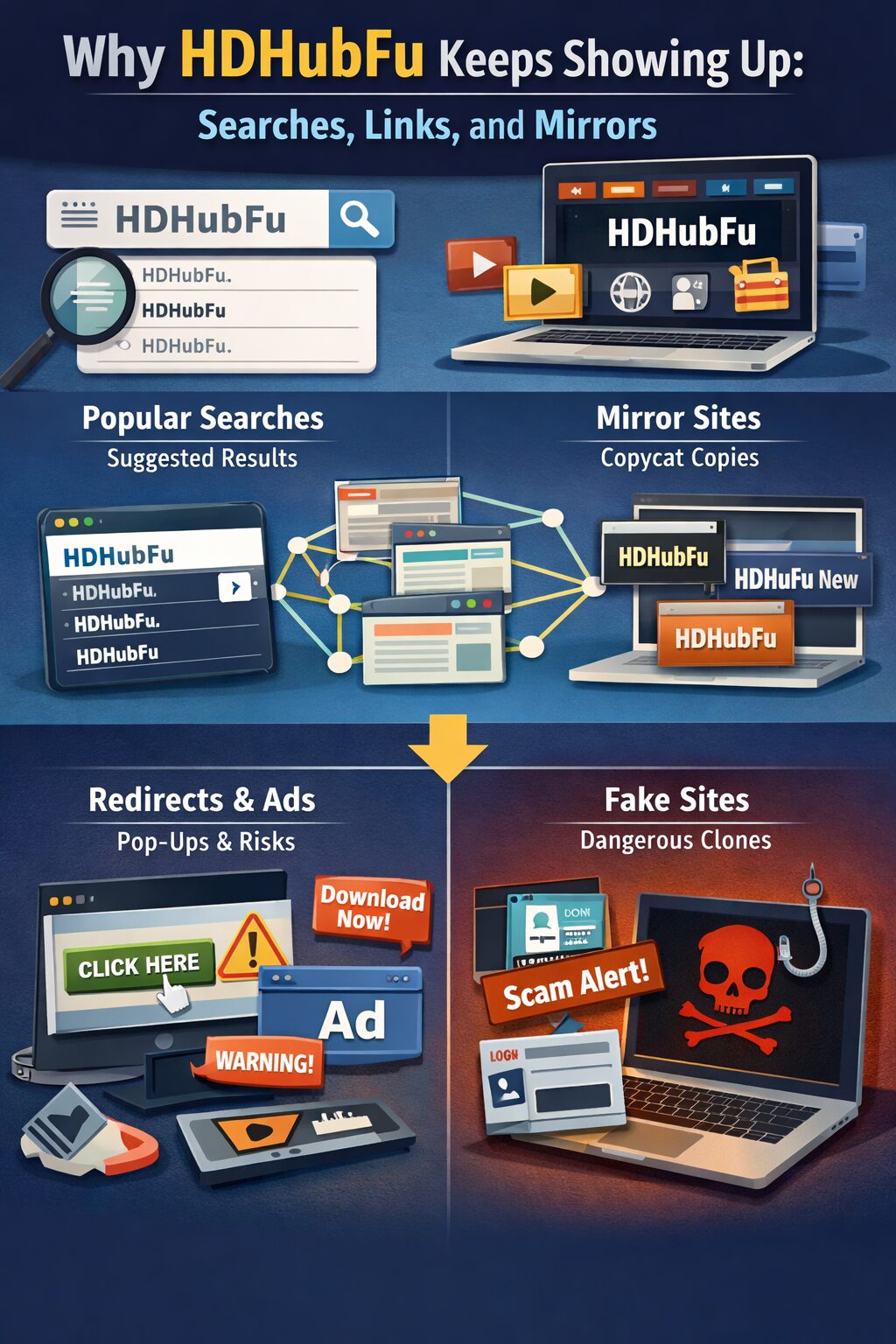
A big reason certain pages spread is simple: links travel. When one page gets shared in a comment section, a messaging group, or a forum thread, other sites copy it to capture the same traffic. Some of those copies are harmless discussions. Others are made to pull people into ad-heavy pages or risky downloads.
There’s also a lot of “link chaining.” One page points to another, which redirects to another, and so on. The final destination can change from day to day. That means the same search result can lead to different places depending on when and where you click, which adds to the feeling that the name is popping up nonstop.
What “mirrors” usually mean and why they multiply
A “mirror” is typically a copy of a site hosted at a different address. Mirrors are common when a page gets removed, blocked, or overloaded with traffic. Instead of rebuilding from scratch, the operators copy the same layout and content and place it elsewhere. That copy may look identical, but it may not behave the same way.
Some mirrors are created by the original operators. Others are created by outsiders who copy the design to trick visitors. This is where things can get dangerous: a fake mirror can be built to push scams, steal login details, or install unwanted software. From the outside, it can be hard to tell which is which.
Why the name appears with random extra words or spellings
You might see the term combined with words like “new,” “latest,” “download,” “watch,” “proxy,” or “link.” These add-ons are often used to match what people commonly search. You may also see spelling variations, extra letters, or different endings. That happens for a few reasons: different language communities, copycat posting, and attempts to dodge filters.
Another common cause is typo traffic. People make small spelling mistakes, and opportunistic pages create near-identical names to catch those searches. Over time, you end up with a messy web of look-alike results. It can feel like the same name is everywhere, but it’s often many different pages using similar text.
How copied pages and scraped content keep the cycle going
A lot of pages that mention HDHubFu don’t create original content. They scrape and repost lists, descriptions, and headlines from other sites. That scraped content gets spread across blogs, forums, and low-effort “directory” pages that exist mainly to collect clicks.
This copying causes two big problems. First, it floods search results with repetitive pages that look different but say the same thing. Second, it makes it harder for search engines to cleanly identify a single “source,” because the content has been duplicated so many times. The end result is more clutter, more confusion, and more repeated appearances.
Redirects, pop-ups, and ad networks: the hidden engine behind repeated results
Many of these pages rely heavily on aggressive ads. That can include pop-ups, fake “play” buttons, and redirect chains that bounce you between sites. Some ad networks rotate destinations based on location, device type, or time of day. So even if you search the same term twice, you might land on two different pages that both look connected.
This is one reason people say the name “keeps showing up.” It isn’t only the search results. It’s the browsing experience after a click—new tabs opening, new pages loading, and repeated branding text appearing in banners and buttons. The repetition is designed to keep you engaged and clicking.
Why it can show up even when you didn’t search for it directly
Sometimes a term appears because your search is related, not identical. For example, searching a popular film title plus words like “watch” or “free” can trigger results that frequently reuse certain labels. If you browse entertainment discussions, your browser history can also influence what you see through autofill and “related searches.”
In other cases, it’s not personalization at all—it’s just common pairing. Certain terms get repeatedly attached to trending titles. So even a neutral search can bring up pages that use the same template-like wording. The connection can feel personal, but it’s usually a broad pattern affecting many users.
Search confusion and name pairing: when unrelated things get mixed together
It’s also possible to see the term paired with unrelated topics—software, sports streams, mobile apps, or random “how to” posts. That happens when low-quality pages try to rank for many different subjects at once. They may reuse the same site name in a footer, sidebar, or tag list, even when the page topic is different.
This can create real confusion. People assume the label must be a legitimate brand because it appears across many subjects. In reality, widespread repetition can be a sign of copy-paste publishing rather than trustworthiness.
The safety risks behind look-alike pages
Not every page that mentions HDHubFu is harmful, but the risk level is higher in spaces filled with clones and redirects. Common problems include deceptive buttons, fake alerts that claim your device is infected, and downloads that are not what they claim to be. Some pages attempt to collect personal information through “sign up” forms or push notification prompts that spam you later.
A helpful mindset is this: if a page makes you rush—“click now,” “allow notifications,” “install this to continue”—it’s not acting in your best interest. Legit services work to reduce friction and increase clarity. Risky pages do the opposite.
How to judge a page without becoming a tech expert
You don’t need special tools to spot many red flags. Pay attention to clarity and behavior. Does the page clearly explain what it offers and who runs it? Or is it mostly ads and confusing buttons? Does it try to force a download for something that should be a simple web video? Does it open extra tabs when you click anywhere?
Also watch for mismatched branding. If the same page name appears with dozens of different designs, logos, and addresses, that’s a sign you’re dealing with a network of copies. Consistency matters. Legit platforms tend to be stable and predictable, not constantly shifting.
Practical steps to reduce exposure and avoid risky clicks
Here are simple actions that can help you stay safer when a term like this keeps appearing in searches or results:
-
Use specific searches that include official platform names when possible
-
Avoid results that rely on “watch free” style wording and vague promises
-
Don’t allow browser notifications from unfamiliar pages
-
Close pages that open multiple tabs or show repeated fake buttons
-
Keep your browser and security updates current
-
If a download starts unexpectedly, cancel it and delete the file
-
Consider using a separate browser profile for casual browsing
These steps don’t require advanced knowledge, but they reduce the chances of being pulled into redirect loops, unwanted installs, or spammy notification traps.
Why mirrors keep coming back, even after removals
When a page or domain gets taken down, the content often doesn’t disappear—it just moves. Copies may already exist, or backups get launched quickly under a new address. Communities that share these links often repost the newest working version, which keeps the cycle alive. Search engines then discover and index the new pages, and the name continues to surface.
It’s also important to remember that removals don’t happen instantly across the whole internet. Even after a page is gone, older copies of search results, reposts, and cached pages can linger for a while. That delay can make it seem like nothing changes, even when specific sources are being removed.
Final Thoughts / Conclusion
HDHubFu keeps showing up because repeated keywords, copied pages, shared links, and shifting mirrors create a constant stream of similar results. Search systems tend to reflect what’s widely repeated, and mirror networks are designed to reappear quickly when anything gets blocked or removed. The result is a confusing mix of look-alike pages that can feel unavoidable.
The good news is you can reduce the risk with simple habits: be careful with vague results, watch for redirect behavior, avoid notification prompts, and stick to clear, legitimate platforms whenever possible. If the name keeps appearing in your searches, it usually says more about how the web spreads repeated content than anything personal about you.
FAQs
What is HDHubFu in simple terms?
HDHubFu is a name that often appears online in connection with entertainment pages that claim to offer movies or shows. It’s widely reused across many pages, so it may not point to one single official source. Because it’s repeated so often, it can show up frequently in search results.
Why does HDHubFu appear in related searches even if I didn’t type it?
Related searches are influenced by what many people commonly search for and click. If a large number of users search a movie title and then search similar phrases that include this name, it can start appearing as a suggestion. This can happen even if you personally never intended to look for it.
What does mirror mean when people mention HDHubFu mirrors?
A mirror usually means a copied version of a site hosted at a different address. Mirrors often appear when a page is removed, blocked, or keeps changing locations. The risk is that some mirrors are made by copycats, so a “mirror” might not be trustworthy.
Is it dangerous to click results that mention HDHubFu?
It can be risky, especially when the result leads to pages full of redirects, pop-ups, or fake buttons. Some pages try to push unwanted downloads or trick users into allowing notifications. If a page pressures you to click quickly or accept permissions, it’s safer to leave.
Why do I see so many different versions of the same kind of page?
Many of these pages are copied and reposted across multiple domains using the same layout and text. Some are auto-generated or scraped from other sources to catch traffic from trending titles. That’s why you may see similar-looking results again and again, even when the addresses differ.
How can I tell if a page is a fake mirror?
Fake mirrors often have clear warning signs: confusing “play” buttons, constant pop-ups, forced notification prompts, and download requests that don’t match what you clicked. They may also open multiple tabs from a single click or show mismatched branding across the page. If the behavior feels pushy or messy, it’s a good reason to close it.
Can HDHubFu show up because of my browser history?
Browser history can influence suggestions like autofill, but it’s not the only reason. The name can also appear simply because it’s widely repeated across many pages online. If you want fewer suggestions, clearing browsing data and turning off autofill can help reduce what you see.
What should I do if I accidentally downloaded something from a suspicious page?
Don’t open the file. Delete it, empty your recycle bin, and run a trusted security scan on your device. If your browser starts acting oddly afterward, check extensions and remove anything you don’t recognize, and reset your browser settings if needed.
ALSO READ THIS : Cartetach Defined Clearly: Meaning, Use Cases, and Notes


Rosboxar Explained: Features, Benefits, and What Makes It Different in 2026

NovaPG Features Breakdown: Everything Users Need to Know This Year

Understanding 9253612736: Uses, Risks, and Safety Tips

Schoology Alfa Features Breakdown: Tools That Enhance E-Learning Experience

Beginner’s Guide to 5134jgg: Definition, Uses, and Trends

Dympigal Explained: Everything You Need to Know in 2026

Top Benefits of KaliScan: Why It’s Gaining Popularity Online

How Jhonbaby777 Is Shaping Online Conversations and Communities

The Ultimate Guide to Understanding Byfsrhlu7g6ewot

MobilesRUs vs Other Mobile Stores: Which One Offers Better Value?
Rosboxar Explained: Features, Benefits, and What Makes It Different in 2026
NovaPG Features Breakdown: Everything Users Need to Know This Year
Understanding 9253612736: Uses, Risks, and Safety Tips
Schoology Alfa Features Breakdown: Tools That Enhance E-Learning Experience
Beginner’s Guide to 5134jgg: Definition, Uses, and Trends
Dympigal Explained: Everything You Need to Know in 2026
Top Benefits of KaliScan: Why It’s Gaining Popularity Online
How Jhonbaby777 Is Shaping Online Conversations and Communities
The Ultimate Guide to Understanding Byfsrhlu7g6ewot
MobilesRUs vs Other Mobile Stores: Which One Offers Better Value?
-

 Technology8 months ago
What Is 001-gdl1ghbstssxzv3os4rfaa-3687053746? Uses Explained
-

 Celebrity8 months ago
Who Is Lauren Deleo? What to Know About Jake Lacy’s Wife
-

 Celebrity8 months ago
Who Is Petra Exton? A Clear Look at Joe Wilkinson’s wife
-

 Blog8 months ago
What Is cilkizmiz24? Explained Clearly: Meaning, Use, and Notes