
Technology
How q1vc4ysicds Gets Decoded: Easy Vigenere Explanation


If you searched for q1vc4ysicds, you probably saw it in a comment, a video description, a social post, or a strange-looking link. It feels random at first glance, like a password or a tracker. But in many cases, strings like this are used as a clue—something meant to be decoded by curious people who enjoy puzzles. This article explains how decoding works in a clear, beginner-friendly way, with a simple focus on one popular method: the Vigenère cipher. You’ll learn what this code-like text can represent, why Vigenère is often used, and how to decode it step by step without needing advanced math or computer skills.
What q1vc4ysicds Looks Like and Why It Gets Attention
A string such as q1vc4ysicds stands out because it mixes letters and numbers in a way that doesn’t match normal words. It doesn’t look like a sentence, a username, or a common file name. That “out of place” feeling makes people want to figure it out. Sometimes it shows up in places where people expect hidden hints, like online mystery threads, creator communities, or short videos where viewers look for puzzles. Other times it appears when someone copies part of a link or saves a file with an auto-generated label. Either way, the real question is usually the same: “Is there meaning here, or is it just random noise?”
Common Places You Might See a Code Like This
Before decoding anything, it helps to know where it came from. A code found in a puzzle community or a creator’s comment section is more likely to be intentional than one found inside a random system log. You might see q1vc4ysicds in a short-form video comment chain where people are sharing hints, or inside a fan wiki thread where viewers track clues. You might also find it inside a URL slug or a copied link that got shortened or altered. And sometimes it appears in usernames, filenames, or tags because platforms generate strings automatically. Knowing the source helps you decide whether decoding is worth your time, or whether it’s simply a technical label.
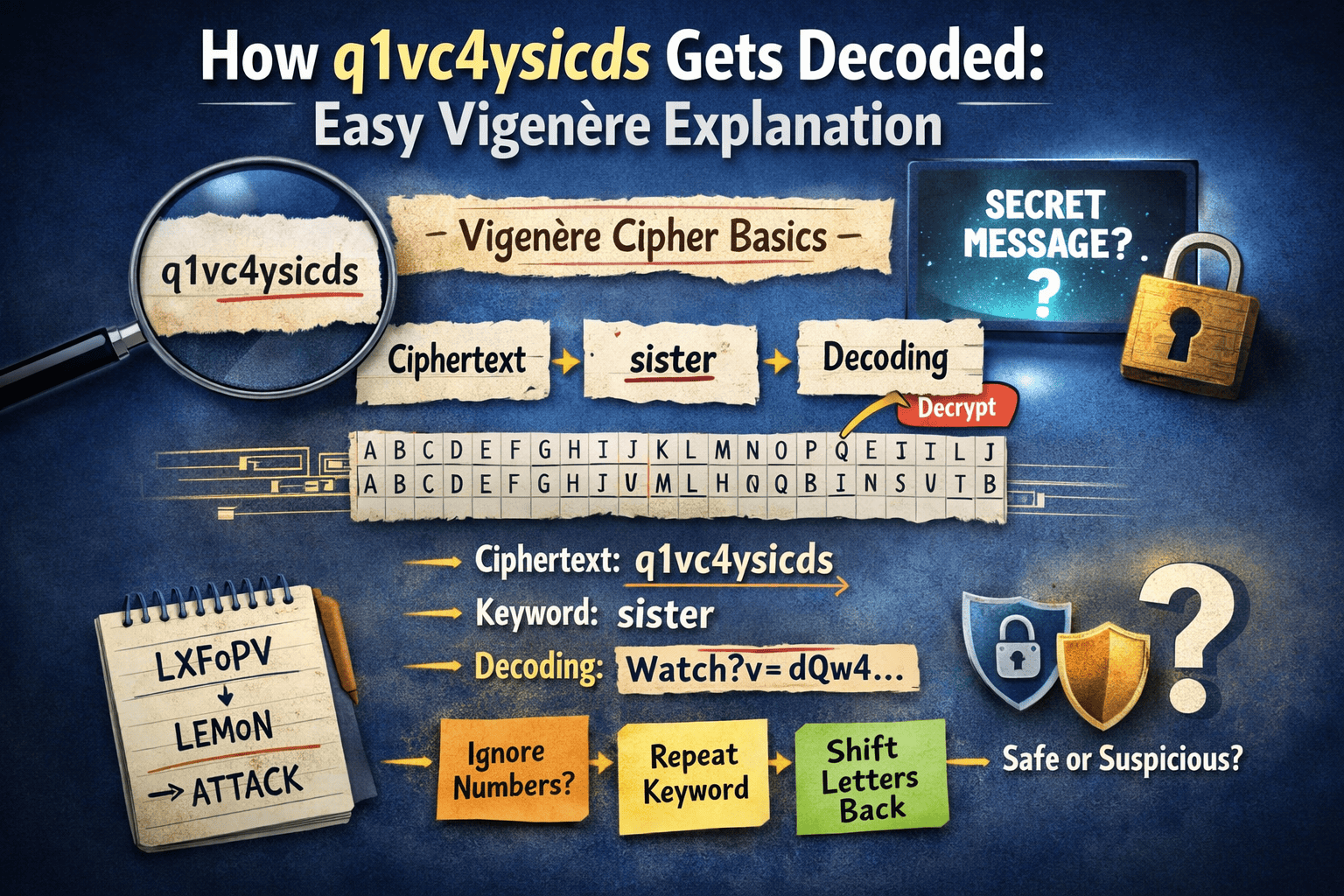
Quick Reality Check: Code, Cipher, ID, or Just Random?
Not every weird string is a cipher. Some are IDs generated by websites, and some are shortened tokens used for tracking sessions or sharing content. So how do you tell the difference? One clue is pattern behavior. If the string appears repeatedly across different posts, or several people are discussing “decoding” it, it’s probably meant to be decoded. If it appears only once inside your browser cache or a random app folder, it may just be a system token. Another clue is how the characters are arranged. Ciphers often look “human-made,” while system IDs may be longer, include special characters, or follow a strict length. q1vc4ysicds is short enough to feel like a deliberate clue, which is why people often try classic cipher methods on it.
What a Vigenère Cipher Is in Plain English
The Vigenère cipher is an old-style way of hiding a message using a keyword. Think of it like shifting letters forward or backward in the alphabet, but with a repeating pattern controlled by the keyword. Instead of using one fixed shift, the keyword creates a changing shift for each letter of the message. This makes it harder to guess than a basic Caesar shift, especially if the keyword is not obvious. The reason Vigenère shows up in online puzzles is simple: it’s easy to do, easy to explain, and easy to verify. You can decode it by hand with a chart, or you can decode it with a simple tool. Either way, it feels satisfying without being too complicated.
Step-by-Step: How People Usually Try Decoding q1vc4ysicds
To decode a string with Vigenère, you usually need three things: the ciphertext (your code), the keyword, and a choice of rules. The ciphertext is q1vc4ysicds. The keyword is the hardest part because it may be hinted at in the surrounding content. Puzzle creators often place the keyword in an obvious place once you know where to look: a repeated word, a character name, a caption, a phrase hidden in a thumbnail, or a “favorite” term in a creator community. Once you have a keyword, you repeat it under the ciphertext letters, line up each letter pair, and shift backward to recover the original message. If your decoded output looks like readable text or a familiar ID, you’re close. If it turns into nonsense, you may have the wrong keyword or the wrong rule for handling numbers.
A Simple Example With a Small Word
Instead of jumping into the full string right away, it helps to understand the mechanics with an easy example. Imagine the coded text is “LXFOPV” and the keyword is “LEMON.” With Vigenère, you repeat the keyword to match the message length, then shift each letter back by the keyword letter amount. That famous example decodes to “ATTACK.” The point isn’t the specific result—it’s the process. The keyword controls how much each letter shifts. This is exactly what people attempt with q1vc4ysicds, but with more uncertainty because we don’t know the keyword in advance and we have numbers mixed in.
How to Handle the Numbers in q1vc4ysicds
When numbers appear inside a cipher-like string, decoders try a few common options. These aren’t “right” or “wrong” until you confirm what the puzzle expects. The typical options are: treat numbers as separators, remove them and decode only letters, keep them unchanged while decoding only letters, or convert numbers into letters using a simple mapping like 1=A, 2=B, and so on. Some puzzle creators use numbers to mislead casual solvers, while others use numbers as part of a platform ID. If your decoded output looks close to something real but not quite correct, the number rule is often the missing piece. That’s why you’ll sometimes see multiple “answers” discussed by different people online.
Signs You’re Getting the Right Decoded Result
Decoding isn’t just about getting any output—it’s about getting an output that makes sense in context. A good decoded result usually has at least one of these signs: it forms a readable word or phrase, it matches a known username, it looks like a platform identifier, it points to a recognizable term in the community, or it connects to the next step of a puzzle. If you get a mix of random letters with no pattern, you might be using the wrong keyword. If you get something that looks like a code used by a website or video platform, you might be on the right track. For online clue-hunting, many decoded results are designed to be “actionable,” meaning they send you to the next clue rather than just giving a sentence.
Practical Tips That Make Decoding Easier
If you want to decode efficiently without going in circles, it helps to use a consistent method and keep notes. Try these approaches in a single, organized workflow: identify the source where you found the string, look for a keyword hint near it, decide how you will handle numbers, decode letters first, and then check if the output matches the context. If you’re working with a group, agree on the rules so everyone gets the same output. Many decoding debates online happen because people used different rules without realizing it. Once you lock the rules, the rest becomes much simpler.
Key Things Decoders Usually Test First
Here are the most common “first tries” people use when decoding a string like q1vc4ysicds. This is the only bullet list in the article, and it’s meant as a quick checklist you can follow:
-
Try a likely keyword hinted by the surrounding post
-
Decode letters only and ignore numbers
-
Keep numbers in place and decode only letters
-
Convert numbers to letters using a simple mapping
-
Test whether the result looks like a name, phrase, or ID
-
Check if the output matches the community’s next step
-
If it fails, try a different keyword before changing everything
-
Keep notes so you don’t repeat the same attempts
When Vigenère Isn’t the Right Tool
Sometimes Vigenère is not the cipher used, even if people assume it is. If you try several reasonable keywords and number rules and nothing works, the string may be something else: a base encoding, a simple substitution, a platform ID, or a random token. A clue can also be multi-step, where you must first transform the string (like removing certain characters) before applying Vigenère. Another possibility is that the “keyword” is not a normal word but a phrase, a name, or a repeated pattern taken from the source material. If the group discussing it is confident about Vigenère, that’s a strong hint, but the exact rules still matter.
What to Do If You Just Want It Gone From Your History
Some people aren’t trying to solve a puzzle. They just want to know why the string appears in browser history, search suggestions, or copied text. In that case, decoding may be less useful than cleanup. If it appears in search history, clearing your recent searches can remove it. If it appears as part of a copied link, check your clipboard history or recent messages. If it appears in saved files, it may be a filename created when you downloaded something or took a screenshot. The key idea is that the string itself is usually not “active.” It’s typically a label, clue, or identifier that can be deleted like any other text entry.
Final Thoughts / Conclusion
q1vc4ysicds looks confusing because it’s short, mixed, and out of context. But the way people decode it is usually not complicated once you understand the basic idea of Vigenère: a keyword controls letter shifts. The real challenge is finding the correct keyword and choosing the right rule for handling numbers. If the string came from a puzzle community, decoding it can be fun and lead to a clear next step. If it came from your device history, it’s often just a harmless label that can be cleared. Either way, you now have a calm, practical understanding of how decoding attempts usually work and what to look for when the first try doesn’t give a clean answer.
Frequently Asked Questions (FAQs)
What does q1vc4ysicds usually mean?
Most of the time, q1vc4ysicds is treated as a coded string or identifier that people believe can be decoded into something readable or useful. In online communities, it often functions as a clue, where the “meaning” is whatever it decodes into. In more ordinary situations, it may simply be a short token or label that got copied into text, a filename, or part of a link.
Is q1vc4ysicds a virus or malware?
The string itself is not a virus. It’s just text. The bigger risk is what it might be attached to, such as a suspicious link or download. If you found it in an email, pop-up, or shady message, avoid clicking anything connected to it. If you found it in a creator community where people solve puzzles, it is far more likely to be harmless.
Why do people use Vigenère to decode strings like this?
Vigenère is popular because it is simple, classic, and easy to explain. It creates a “hidden message” effect without requiring advanced knowledge. Puzzle makers like it because it can be solved with basic steps, and solvers like it because it feels fair: if you have the keyword and the rules, you can confirm the result.
What keyword should I use to decode q1vc4ysicds?
The keyword is usually hinted at where the string appeared. It could be a repeated word, a name, a theme word, or something the creator emphasizes. If there’s a community discussion around it, people often share theories about the keyword. The best approach is to look for the most “obvious” candidate in the surrounding content and try that first.
How do I decode it if the string includes numbers?
Numbers complicate classic Vigenère because the original method focuses on letters. Many solvers either ignore numbers, leave them unchanged, or convert them into letters using a simple rule. If your decoded output looks almost correct, the number-handling rule is often the missing piece. Try one rule at a time so you can see what changes.
What if my decoded result looks like nonsense?
That usually means one of three things: the keyword is wrong, the rules for numbers are wrong, or the cipher is not Vigenère at all. Try a few different keyword ideas before switching to a completely different cipher. Also confirm whether the decoding expects you to remove certain characters first.
Can q1vc4ysicds decode into a platform ID or link clue?
Yes, that’s a common design in online puzzles. The decoded output may not be a sentence. It might be a short name, a tag, or something that looks like an identifier used by a platform or community. If the output matches the style of the next step in the puzzle, that’s often a sign you’re close.
Why does q1vc4ysicds show up in my search or browser history?
It can appear because you searched it, clicked something containing it, copied a link with it, or visited a page where it was visible. Sometimes your browser stores strings from pages you open, and they later appear in suggestions. If you don’t want it there, clearing recent history and recent searches usually removes it.
ALSO READ THIS : How to Remove kiozllcojiz2202 From Chrome, Safari, and Firefox

Rosboxar Explained: Features, Benefits, and What Makes It Different in 2026

NovaPG Features Breakdown: Everything Users Need to Know This Year

Understanding 9253612736: Uses, Risks, and Safety Tips

Schoology Alfa Features Breakdown: Tools That Enhance E-Learning Experience

Beginner’s Guide to 5134jgg: Definition, Uses, and Trends

Dympigal Explained: Everything You Need to Know in 2026

Top Benefits of KaliScan: Why It’s Gaining Popularity Online

How Jhonbaby777 Is Shaping Online Conversations and Communities

The Ultimate Guide to Understanding Byfsrhlu7g6ewot

MobilesRUs vs Other Mobile Stores: Which One Offers Better Value?
Rosboxar Explained: Features, Benefits, and What Makes It Different in 2026
NovaPG Features Breakdown: Everything Users Need to Know This Year
Understanding 9253612736: Uses, Risks, and Safety Tips
Schoology Alfa Features Breakdown: Tools That Enhance E-Learning Experience
Beginner’s Guide to 5134jgg: Definition, Uses, and Trends
Dympigal Explained: Everything You Need to Know in 2026
Top Benefits of KaliScan: Why It’s Gaining Popularity Online
How Jhonbaby777 Is Shaping Online Conversations and Communities
The Ultimate Guide to Understanding Byfsrhlu7g6ewot
MobilesRUs vs Other Mobile Stores: Which One Offers Better Value?
-

 Technology8 months ago
What Is 001-gdl1ghbstssxzv3os4rfaa-3687053746? Uses Explained
-

 Celebrity8 months ago
Who Is Petra Exton? A Clear Look at Joe Wilkinson’s wife
-

 Celebrity8 months ago
Who Is Lauren Deleo? What to Know About Jake Lacy’s Wife
-

 Celebrity8 months ago
Who Is Ilan Tobianah? Early Life, Lawyer Career, and Net Worth